
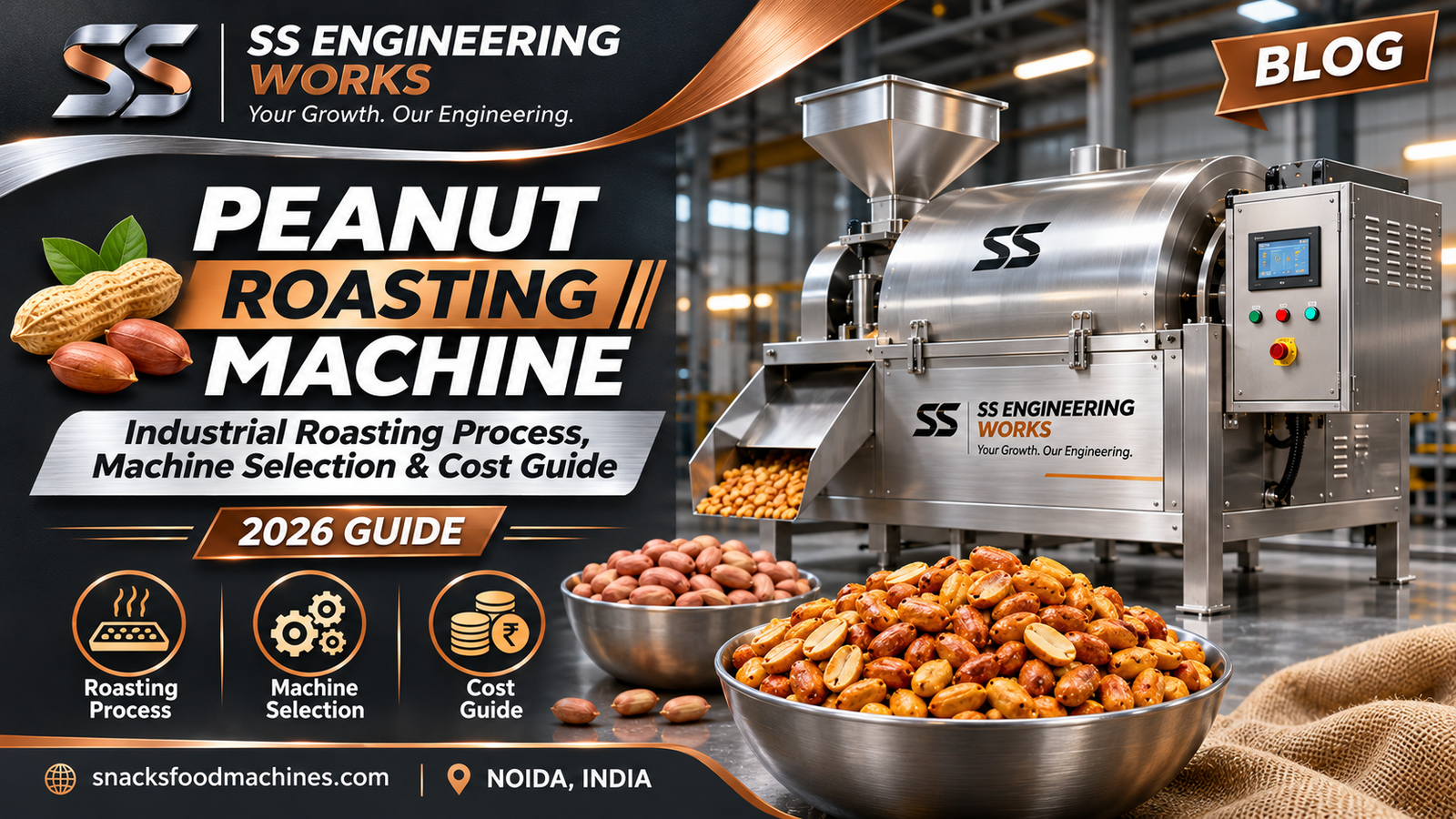
PEANUT ROASTING MACHINE
Industrial Roasting Process, Machine Selection, Batch Output, Food Safety & Investment Planning
Explore This Article ☰
What Is a Peanut Roasting Machine?
A peanut roasting machine is industrial food processing equipment used to heat suitable groundnuts under controlled conditions to develop the required roasted flavour, colour and texture. Depending on the application, buyers may need a batch roaster or a continuous production arrangement.
Roasting is a key process in producing plain roasted peanuts, flavoured peanut snacks, ingredients for peanut products and other suitable nut applications. Successful production depends on more than applying heat. Raw material quality, roast profile, product movement, cooling and storage all influence the finished result.
Buyers sometimes search for a groundnut roasting machine, industrial peanut roaster, nut roasting machine or automatic peanut roasting machine. These names can describe different machine designs. Compare the real processing method and specifications, not the name alone.
Start with a peanut sample, the desired roast level and the actual output you need. Then choose machinery and heating equipment that can be evaluated against those conditions.
SS Engineering Works' Dry Fruit Roasting Machine is a relevant product page for nut roasting project enquiries. Peanut compatibility, heating arrangement, cycle basis and model specifications must be established for the proposed machine.
This blog focuses specifically on peanut roasting operations and finished product quality. For a broader discussion of machinery costs across nut varieties, read the existing Dry Fruit Roasting Machine Price in India Guide .
Peanut Roasting Machine Working Process: 7 Production Stages
The industrial peanut roasting process begins before the raw material reaches the heating equipment. Receiving, sorting, roasting and downstream handling must work together to produce a safe, consistent snack.
Raw Peanut Receiving
Receive groundnuts from approved suppliers and assess the lot against documented quality requirements. Check its grade, physical condition, moisture and traceability information.
Cleaning & Sorting
Remove foreign material and unsuitable kernels using the appropriate sorting and cleaning process. Damaged, mouldy or suspect peanuts require controlled rejection and food-safety handling.
Batch Loading or Continuous Feeding
Load the machine using its approved capacity and feeding method. Batch equipment and continuous systems have different loading patterns, residence times and output calculations.
Controlled Roasting
Heat is transferred to the peanuts through the selected roasting arrangement. The validated process considers temperature, time, product movement, starting condition and target roast quality.
Discharge & Cooling
Roasted peanuts are discharged and cooled using a suitable arrangement. Cooling and product transfer must be planned to reduce unwanted further cooking and protect product hygiene.
Seasoning or Further Processing
If required, peanuts may undergo flavouring, coating or another approved downstream operation. Each additional stage must be specified separately in the proposed equipment scope.
Quality Checks & Packaging
Review finished colour, texture, flavour, food safety requirements and pack suitability. Use appropriate hygienic handling and packaging before storage and distribution.
There is no universal roasting time or temperature suitable for every peanut grade and roaster. Published research shows that different time-temperature combinations can produce different product characteristics even at comparable roast colours.
For technical background, see the published study on industrial dry-roasting conditions and peanut quality . Its test conditions are research results, not operating instructions for an SS Engineering Works machine.
Batch vs Continuous Peanut Roasting Machine
Two common industrial approaches are batch roasting and continuous roasting. The choice depends on the required output, product variation, utility availability and connected production stages. The heating method also needs separate evaluation.
Batch Peanut Roaster
A defined quantity of peanuts is processed through a roasting cycle. Practical output must account for loading, heating, discharge, changeover and relevant cooling.
This approach may be relevant when product recipes or batch sizes change frequently, subject to the machine configuration.
Continuous Peanut Roaster
Product is fed through a roasting arrangement intended for ongoing flow. The production line must coordinate feeding, heating, residence time, discharge and cooling.
A continuous system should be evaluated against actual saleable hourly output and downstream capacity.
| Decision | Batch Roaster | Continuous Roaster |
|---|---|---|
| Operating Pattern | Separate processing cycles | Ongoing product flow |
| Capacity Basis | kg/batch plus cycle time | kg/hour at agreed conditions |
| Product Changeover | Review loading and recipe flexibility | Review startup, transition and changeover losses |
| Line Integration | Loading and discharge handling | Feeding, conveying and cooling interfaces |
| Cost Comparison | Complete batch cycle economics | Complete line throughput economics |
An electric, gas-fired, hot-air, drum-style or other roasting method should not be assumed from the words "batch" or "continuous". Request confirmation of the actual heating design, fuel or electricity requirement, safety controls and site installation needs.
Important Parts of an Industrial Peanut Roaster
Before requesting a machine quotation, understand which functions belong to the roaster and which are separate equipment or project requirements. Actual construction varies by model.
Loading & Feeding
The input arrangement must suit the intended product, batch size and safe operator handling method.
Roasting Chamber
The product is heated using the configured roasting method. The heating source and internal arrangement require specification.
Temperature & Time Controls
Review the controls, measurement points, operating modes and adjustment functions provided on the selected equipment.
Agitation or Conveying
Some roasters use product movement to support process uniformity. The actual movement method is machine-specific.
Discharge System
Product leaves the machine through the chosen discharge arrangement. Review handling height, access and downstream collection.
Cooling & Packing
Cooling, conveying, seasoning and packing may require additional equipment not included with a standalone roaster.
Roasting method, applicable nut products, batch or hourly capacity, heating utility, controls, food-contact surfaces, cleaning access, safety features and included downstream machinery.
How to Improve Peanut Roasting Quality
Peanut quality depends on both incoming raw material and the validated roasting method. Process control should aim for the required colour, taste, aroma and texture while preventing avoidable burning or inconsistent batches.
| Quality Issue | Possible Reason | Recommended Review |
|---|---|---|
| Uneven Roasting | Nut size variation, material movement or heating differences | Raw material grading, loading and roast uniformity |
| Over-Roasted Peanuts | Unsuitable roast profile or excessive heat exposure | Validated time-temperature conditions and discharge |
| Under-Roasted Product | Insufficient or inconsistent process exposure | Product sampling, agreed quality criteria and process validation |
| Broken Kernels | Fragile raw material or rough transfer | Input grading, handling and product movement |
| Quality Variation Between Lots | Changes in peanut variety, moisture or storage | Incoming specifications and batch records |
A practical production record may include raw material lot number, starting condition, loading quantity, chosen roast programme, measured processing values, operator, finished product checks and rejection data. This makes repeated quality problems easier to investigate.
Ask for trials using your actual raw peanuts and a reference sample of the intended finished roast. A machinery demonstration with unrelated materials may not represent your production results.
Peanut Roasting, Aflatoxin Risk & FSSAI Compliance
Peanut processing requires a food-safety plan that begins with raw material sourcing. Aflatoxins are toxins associated with certain fungi, and contaminated groundnuts can present a serious food-safety risk.
Roasting should never be treated as a guarantee that contaminated peanuts become safe. Incoming raw material controls, suitable sampling and testing, moisture management, sorting, storage and regulatory compliance are essential.
The FSSAI guidance on aflatoxins discusses prevention, raw material management, storage and monitoring. Buyers should establish suitable procedures before production starts.
- Use approved peanut suppliers and traceable lots.
- Inspect and reject mouldy or suspect raw materials.
- Follow appropriate aflatoxin testing and acceptance rules.
- Keep equipment, storage and handling areas hygienic.
- Use a validated roasting and product-quality process.
- Prevent cross-contamination and control peanut allergen risks.
- Use compliant packaging, labelling and storage practices.
Food businesses in India must evaluate applicable licensing, hygiene and food-safety requirements. Refer to the official FSSAI hygiene requirements and the FoSCoS licensing portal for current regulatory information.
7 Best Tips Before Buying a Peanut Roasting Machine
Choosing an industrial peanut roasting machine is both a technical and commercial decision. These checks help you compare quotations against the same production requirements.
Define Your Peanut Product
Identify the nut variety, starting condition, desired roast level and whether you will sell plain, salted, flavoured or further processed peanuts.
Compare Real Output
Distinguish raw kilograms per batch from finished saleable kilograms per hour. Include loading, roasting, unloading and cooling time when comparing complete line output.
Confirm the Heating Method
Review the quoted electric, gas or other heating arrangement, connected utility requirements, ventilation and process controls. Never assume a heating type from an advertising image.
Review Product Uniformity
Ask about trials using your peanut grade. Compare roast colour, flavour, texture, damaged kernels and repeatability between batches.
Check Cleaning & Safety
Review access to food-contact parts, safe loading and discharge, operator guards and maintenance arrangements for the selected model.
Plan Cooling & Packaging
Confirm whether cooling, seasoning, transfer, weighing and packing machinery are included, optional or supplied separately.
Get a Detailed Written Quotation
Request machine specifications, utilities, included components, installation responsibilities, warranty, delivery assumptions and service conditions in writing.
When comparing manufacturers, ask for the same starting peanut material, target roast, output basis and equipment scope. Comparing only machine photographs or broad category names can be misleading.
Peanut Roasting Machine Price in India: Major Cost Factors
The peanut roasting machine price in India depends on the selected equipment model, heating arrangement, output capacity, materials of construction, operating controls and project supply scope.
A standalone roaster may have a substantially different quotation from a connected line with feeding, cooling, flavouring, conveying and packing equipment. Installation, site utilities and working capital should also be considered separately.
Equipment Investment
Roaster configuration, heating, control system, accessories and agreed supply scope.
Process Expenses
Raw peanuts, heating energy, labour, quality checks, rejects and maintenance.
Business Expenses
Packaging, storage, freight, distribution, working capital and sales-related expenses.
Questions to Ask Before Paying
Does the capacity refer to kilograms of raw nuts per batch or finished output? Is the quoted model suitable for your grade of peanut? What is the operating cycle? What equipment is included? Who handles installation, electrical connections, training and commissioning?
SS Engineering Works can review your project requirements through the official machinery enquiry page . Machine price, ready stock and delivery must be confirmed through a current quotation rather than assumed from this article.
Peanut Roasting Business: Interactive Batch Output & Cost Calculator
Use this planning calculator to estimate monthly roasted-peanut output and a simplified business contribution based on your own inputs. The starting figures are illustrative assumptions only, not SS Engineering Works model ratings, current market prices or guaranteed profits.
Monthly Peanut Roasting Scenario
Use actual equipment and cost information. This simplified model assumes complete batches and a finished-yield percentage. It does not establish profit, food safety, sales demand, investment payback or machine performance. Any financing, taxes, depreciation and other expenses not included in the entered values are excluded.
How to Calculate Practical Roasting Output
Begin with the accepted raw quantity per batch. Estimate the complete cycle time, including loading, roast, discharge and any relevant batch handling delays. Apply a realistic productive-time percentage and use only complete batches in the estimate.
Finished output can differ from raw input weight due to moisture changes, sorting, damage and handling losses. Validate the yield using product trials rather than assuming a fixed result for every peanut variety.
For continuous equipment, request a separate output estimate based on measured kilograms per hour and the full connected line's available operating time.
Peanut Roasting Machine FAQs
What is a peanut roasting machine used for?+
It is used to roast suitable raw peanuts under controlled processing conditions to develop the desired roasted characteristics.
What is the peanut roasting machine price in India?+
Pricing depends on the model, heating arrangement, capacity, controls, construction and equipment included in the quotation.
Which is better: batch or continuous roasting?+
The appropriate choice depends on output requirements, raw material, product changeovers and factory integration. Compare practical production performance, not just advertised capacity.
Can the same machine roast peanuts and cashews?+
Some roasting equipment may support multiple compatible nuts, but each material requires a separate suitability review and validated process.
Does roasting remove aflatoxin contamination?+
Roasting must not be relied upon to make contaminated peanuts safe. Follow raw material acceptance, testing and applicable food-safety controls.
How do I calculate batch roasting capacity?+
Use the accepted raw weight per batch, complete batch cycle and productive operating time. Then account for finished yield and quality losses.
Does a roaster include cooling and seasoning?+
Not necessarily. Confirm the actual included machinery, optional equipment and downstream handling stages in the written proposal.
Where can I enquire about a nut roaster in Noida?+
Contact SS Engineering Works, Greater Noida, India, with your peanut sample, target roast, output requirement and available heating utilities.
Looking for a Peanut Roasting Machine Manufacturer in India?
SS ENGINEERING WORKS can discuss industrial nut roasting machinery based on your raw peanut sample, target roast, proposed capacity and factory requirements.
General educational content only. Featured machinery visuals are illustrative and may not depict the actual quoted model. Processing conditions, performance, food safety, availability, pricing and commercial terms require project-specific verification.